

September 3, 2026

As a leading supplier to industries that are reshaping the world’s economy, 5N+ must evolve alongside its customers, anticipate their needs and be ready to scale up production if demand for a new advanced material takes off.
With this goal in mind, one of the projects that has mobilized our Montréal research and development team is the development of perovskite precursors, a suite of specialty semiconductor compounds that could usher in the next generation of solar cells. Here is a closer look at this potential market.
More efficient solar cells
Perovskite-based solar cells have generated high interest among researchers and solar panel manufacturers because they have shown promising results in converting sunlight to electrical power. Improving the conversion performance of solar panels could help decrease the amount of land and resources required in the transition to clean energy, which is happening at a fast clip: BloombergNEF estimates that solar will become the world’s largest generator of electricity by 2032.
Best research cell efficiencies
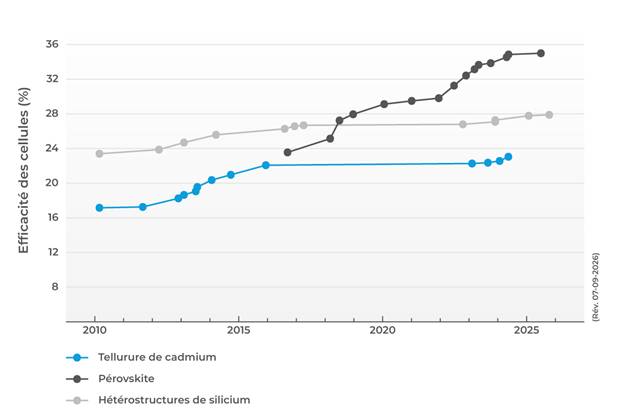
Source: National Laboratory of the Rockies, Photovoltaic Research.
The most discussed use of perovskites is in photovoltaic tandem cells, which typically stack a perovskite cell on top of a thicker silicon one to boost its efficiency. While results can vary widely, research shows that the power output obtained from tandem cells is at least one-third higher than from silicon cells alone. Perovskite-based cells could also be stacked onto cadmium telluride cells or used on their own.
The 5N+ team had been tracking this technology for several years before deciding to make it a project of its own, in 2024.
“As the noise grew around it, we initiated research and some fundamentals tests, anticipating clients would move in that direction,” 5N+ Corporate Development Director Thomas Feldmann says. “A few months later, some of our biggest customers publicly confirmed that they were working on it.”
Advanced compounds clients can tailor to their needs
The term perovskite cell refers to the absorbing semiconductor layer crystal structure that is in a solar cell.
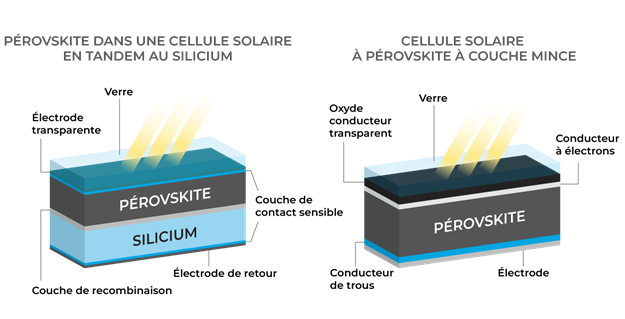
Source: U.S. Department of Energy, Integrated Systems Office, Perovskite Solar Cells.
Drawing on its deep expertise in compounding and purification processes, 5N+ has already developed seven perovskite precursors that clients combine to manufacture that light-absorbing layer to their specifications. These have also undergone quality evaluation from independent, third-party experts.
“Clients use different deposition methods to achieve the perovskite layer, but our materials are agnostic to their process,” Feldmann explains.
The suite of precursors is comprised of lead, cesium and formamidinium halides that come in tailored particle size.
|
5N+ Perovskite Precursors |
||
|
Lead Halides |
Cesium Halides |
Specialized Halides |
|
Lead Iodide |
Cesium Iodide |
Formamidinium Iodide |
|
Lead Chloride |
Cesium Chloride |
|
|
Lead Bromide |
Cesium Bromide |
|
Is perovskite technology the future?
Low sourcing constraints have convinced some academics that perovskite-based cells will take over the entire photovoltaic solar cell market by 2050. But 5N+ Head of R&D Frédéric Bélanger sees a cautionary tale in copper indium gallium diselenide (CIGS) solar technology, which also showed early promise but has yet to successfully scale beyond lab-level performance.
“The main hurdle for the solar industry is to prove the long-term stability of the perovskite solar cells, which are sensitive to heat, oxygen and moisture, and can lose efficiency quickly,” Bélanger explains.
Several solar technology companies have invested in pilot plants aiming to implement and scale tandem and standalone perovskite solar module production approaches. Feldmann and Bélanger anticipate that a few of them may grow into full production mode within a few years’ time.
While R&D is most advanced for terrestrial solar applications, perovskite technology could eventually find applications in other markets, including space solar power. Its broader potential, however, will depend on whether the technology can demonstrate the durability, scalability and cost-effectiveness required for commercial deployment.
Drawing from experience
While the outlook for the perovskite market is still unclear, 5N+ is making sure it is prepared to support its clients and meet a potential surge in demand. That implies mastering the physical properties of the product but also understanding its value chain and sourcing opportunities.
To that end, it can draw on its experience ramping up production of cadmium telluride for the solar industry, which started in the kilos, grew to large volumes and only keeps increasing.
“We’ve done it in the past, and we intend to do it with the perovskite-based solar industry as it evolves,” Feldmann says. “If our clients ramp up production, we will produce precursors at a relevant scale to supply the market.”