

November 9, 2026
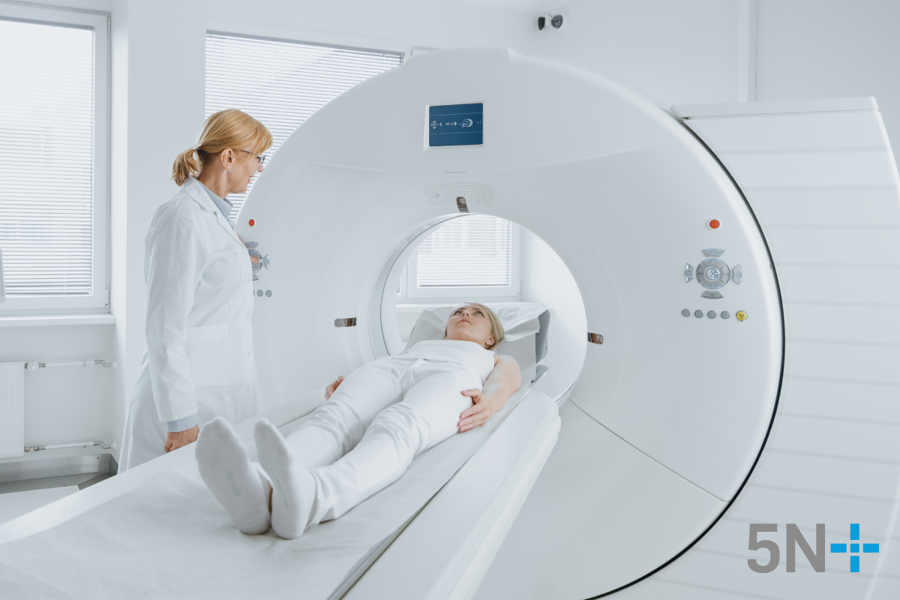
Photon-counting technology is beginning to reshape computed tomography (CT), enabling higher-quality images with the potential for lower radiation doses. 5N+’s advanced materials already play an important role in conventional medical imaging applications, including sensor materials used in radiation detectors.
Building on its established industry position, 5N+ is now helping advance the next generation of CT scanners through photon-counting technology, working closely with companies such as Samsung to develop advanced sensor materials optimized for their imaging systems.
From conventional to photon-counting detectors: a new paradigm
Since their development in the 1970s, CT scanners have become a staple of modern medicine, using X-rays and computer processing to create detailed cross-sectional images of organs, tissues, bones and blood vessels. In conventional detectors, a scintillator converts X-ray energy into visible light, which is then transformed into electrical signals and processed into 3D images.
Although innovation has reduced scan times, image noise and radiation doses, conventional CT technology has approached its practical limits, prompting researchers to explore a different approach starting in the early 2000s.
Photon-counting CT can use direct-conversion semiconductor sensor materials like cadmium telluride (CdTe) or cadmium zinc telluride (CZT), while other architectures use silicon. These materials convert X-ray photons directly into electrical signals without the intermediate light-conversion step. The detector can then count individual photon events and sort them by energy, enabling more precise imaging and spectral information.
Quantum HD cardiac images offer a resolution of 0.2 mm slice thickness for coronary plaque assessment.
“A conventional detector mainly tells you how much X-ray energy arrived. A photon-counting detector gives you information about the individual photons and their energy,” says Brock Alexander, Vice President, Government and Defense, and Site Manager of 5N+’s St. George, Utah facility. “It is a bit like going from black and white to 4K colour.”
The technology can also support a lower radiation dose for the same diagnostic task, an important benefit for children or for patients who need repeated scans. While the first commercial photon-counting CT scanner was introduced in 2021, adoption remains in its early stages, with cost still a barrier for budget-constrained hospitals. As clinical evidence grows and competition increases, Alexander expects adoption to broaden. For perspective, one U.S. detector maker has publicly estimated the medical photon-counting detector opportunity at about US$500 million by 2029.
Partnering with customers across the value chain
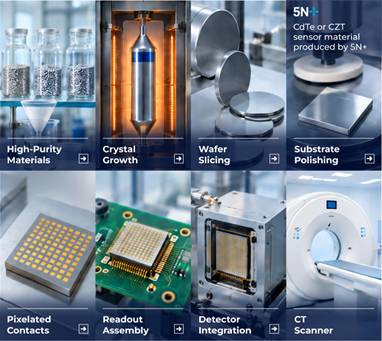
The photon-counting detector value chain begins with high-purity materials, which 5N+ supplies and transforms into CdTe or CZT semiconductor crystals and substrates. The sensor material is then integrated with the customer’s application-specific integrated circuit, or ASIC, and electronics. Because the material and electronics must perform as a single detector, development requires extensive testing and close collaboration across the value chain.
“The sensor material represents a small share of a CT scanner system’s cost but a large share of the detector’s performance,” Alexander says. “We are not simply making a crystal to a dimensional specification and shipping it. We work across the value chain to make sure the material performs with the customer’s ASIC and detector architecture. The reason we go downstream is simple: we need to know whether the work we did upstream worked.”
The photon-counting detector value chain
For 5N+, this kind of cooperation has developed over many years. A multi-year development program with Samsung and its NeuroLogica subsidiary led to a long-term supply agreement, announced in 2021. The experience has enabled 5N+ to deepen its knowledge around purification, crystal growth and finishing, and detector response.
Beyond medical imaging
The expanding 40,000-sq-ft St. George facility became part of 5N+ in 2014. Originally focused on germanium wafers for satellite solar cells, the site now grows and finishes multiple semiconductor crystals for space, defence, medical and industrial applications.
While defence opportunities have grown rapidly, photon-counting technology remains an important business for 5N+ with considerable untapped potential – including beyond medical applications.
“Much of the underlying technology is similar,” Alexander explains. “You still have an X-ray source, sensor material, detector electronics and image-processing system, but instead of imaging a patient, you may be inspecting an aerospace component, battery, casting, weld, electronic assembly or another manufactured part. In nuclear power, that could eventually include thick-wall piping, pressure vessels and other critical components where you need to see what is happening inside the material without cutting it apart,” he adds.
Capabilities once limited to larger instruments could also move into compact, portable systems, including handheld radiation detectors, wearable sensors and drone-based radiation mapping. These systems could be particularly valuable following an incident at a nuclear facility.
“The breakthrough is not just the cadmium telluride or cadmium zinc telluride material. The material, the ASIC and the electronics have to work together as one detector. That is what makes the technology work,” Alexander concluded.
With its materials expertise, customer partnerships and ability to support applications from development through commercialization, 5N+ is well positioned to play a critical role as photon-counting technology gains broader adoption in medical imaging and beyond.