

October 20, 2026
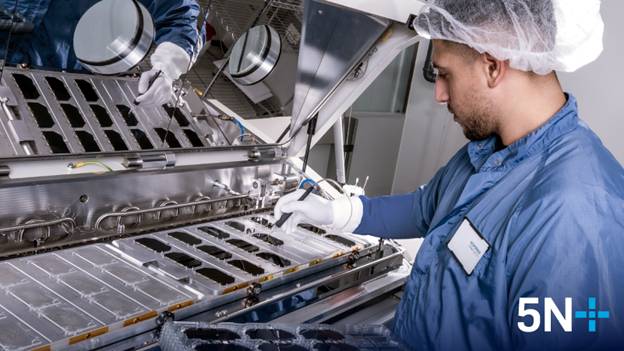
Could a solar cell technology that has helped power hundreds of satellites and deep space missions be one day used for planes and cars? What would it take to lower production costs?
In the process of researching and testing potential terrestrial applications, 5N+’s AZUR SPACE subsidiary recently contributed to two world records for photovoltaic module efficiency.
Here’s what the future could look like.
Project Vorfahrt
Ever since supplying the solar cells for the first German satellite, some 57 years ago, Heilbronn, Germany-based AZUR has grown into a global leader in the development and production of multi-junction solar cells, based on III-V compound semiconductor materials (materials made from elements that come from Groups III and V of the periodic table).
These cells, designed for demanding space applications, became the basis for a research project seeking to adapt the technology to other industries that would benefit from its high efficiency. Project Vorfahrt (which means “priority,” as in the right of way for drivers) set out to develop and test new cells and modules with four manufacturing partners, Electra Solar, Gochermann Solar Technology, Temicon and Audi AG, and academic partner Fraunhofer Institute for Solar Energy Systems (Fraunhofer ISE).
“The aim was to make new applications possible by scaling up production and reducing costs,” says Tim Kubera, Senior Expert, Future Competitiveness, who led the project on the AZUR SPACE side with the support of colleagues Kristof Möller, Samuel Brückmann and Ivica Zrinscak. “We identified two industries where high volumes could enable economies of scale: photovoltaic-powered planes, as a first step, and the automotive industry, once costs come down.”
The Most Efficient Solar Module in the World
A key goal of the project was to demonstrate the potential of the technology by reaching new efficiency levels. To that effect, AZUR SPACE adapted its triple III-V germanium cells to the terrestrial solar spectrum, which scientists at Fraunhofer ISE then used to build an 833-square centimeter module. In addition to the cell technology from AZUR SPACE, a high-packing-rate shingling interconnection technology from Fraunhofer ISE and an advanced nano-structured ultra-low-loss optical coating were also applied to accomplish this.
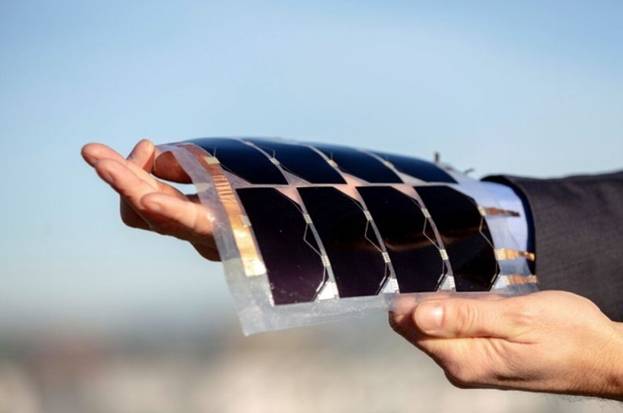
Semi-flexible PV module manufactured at Fraunhofer ISE with III-V tandem solar cells from AZUR SPACE Solar Power GmbH (Source: Fraunhofer ISE)
In early 2026, the module converted an impressive 34.2 percent of sunlight into electricity, a world efficiency record made possible by AZUR SPACE’s 3T34 solar cells, which were interconnected and laminated by the project partners. As a comparison, the previous record stood at 32.7 percent.
Through optimized process steps, optical and electrical losses within the module were almost eliminated, preserving the cell’s performance. Our 150 mm wafer platform delivered top quality and homogeneity for nearly all the wafers used.
It didn’t stop there. The consortium went on to surpass its own achievements just a few months later by arranging solar cells in an improved shingle-like pattern called the matrix-shingle technique. This further improved module performance under partial shading and attained an even higher efficiency of 34.4 percent. The breakthrough results were presented in September in Rotterdam at the 43rd European Photovoltaic Solar Energy Conference and Exhibition.
“The cell’s efficiency performance surpassed the goals we had established for this project,” says Kubera. “They confirmed the strength of the technology.”
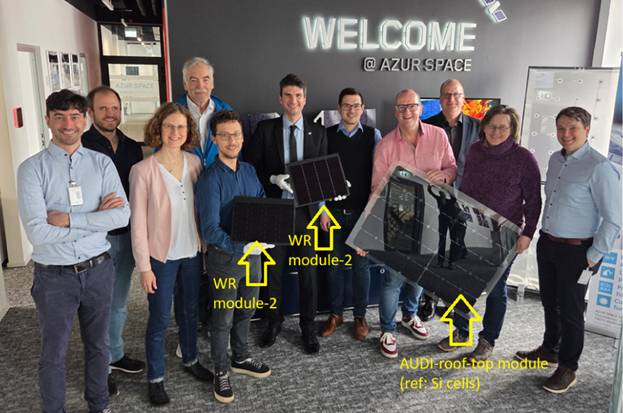
The Project Vorfahrt team, from left to right: Dr. Hubert Hauser (Temicon), Dr. Oliver Höhn (Fraunhofer ISE); Dr. Laura Stevens (Fraunhofer ISE), Calin Gologan (Electra Solar), Leonhard Böck (Fraunhofer ISE), Tim Kubera (AZUR SPACE), Samuel Brückmann (AZUR SPACE), Oliver Gochermann (Gochermann Solar Technology), Dr. Georg Altenhöfer-Pflaum (Jülich Project Management Organization), Dr. Annegret Matthai (Audi AG), Dr. Martin Heinrich (Fraunhofer ISE)
What’s next?
The final chapter of the Vorfahrt project entails the construction and testing of an III-V car roof top module using AZUR SPACE solar cells and conceived in partnership with Audi. The module is now being finalized and will provide another opportunity to demonstrate the technology’s potential (albeit at a small scale) on vehicles with limited space.
While generating part of a car’s electricity needs directly from its roof would be a gamechanger, significant work remains before the technology can be produced economically at scale. AZUR SPACE continues to pursue various pathways to reduce cell and module costs and broaden the technology’s potential terrestrial applications in future.
Commercial adoption of the applications explored through Project Vorfahrt may still be some distance away, but AZUR SPACE’s technology is already demonstrating its value beyond space. As an example, in 2023, its high-efficiency solar cells became key components of RayGen’s flagship solar power generation and storage plant in Carwarp, Australia.
These projects reinforce a much broader opportunity. By combining its deep expertise with the capabilities of academic and industry partners, AZUR SPACE will continue pushing the boundaries of solar cell efficiency and exploring applications where its technology can deliver the greatest value.
After helping power satellites, deep-space missions, energy storage plants and experimental aircraft, what will AZUR SPACE’s solar cells do next?