

September 4, 2026
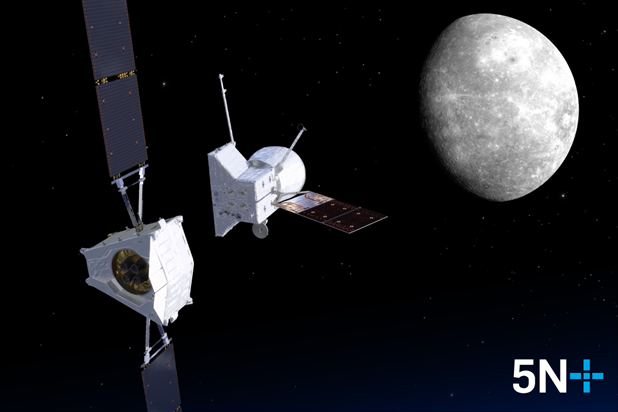
Image: © ESA
Our very own AZUR SPACE solar cell technology, manufactured in Heilbronn, Germany, has once again supported one of the most demanding interplanetary journeys ever undertaken.
Yesterday, the European Space Agency’s BepiColombo mission reached a major milestone when its Mercury Transfer Module successfully separated from the mission’s two scientific orbiters, marking the ‘arrival phase’ of this critical mission.
BepiColombo is a joint mission of the European Space Agency and the Japan Aerospace Exploration Agency and it represents the most complex mission ever to orbit Mercury. It is the first designed to place two spacecraft in orbit around Mercury simultaneously and only the second mission ever intended to orbit the planet.
AZUR SPACE solar technology engineered for extreme conditions
Operating near Mercury presents exceptional challenges. At its closest points to the Sun, BepiColombo is exposed to solar intensity approximately 10 times greater than that experienced in Earth orbit.
Dating back to 2015, AZUR SPACE developed and manufactured gallium arsenide triple-junction solar cells which are embedded in the spacecraft solar arrays. The cells are engineered for illumination levels of up to 11 solar constants and temperatures reaching 200 degrees Celsius.
The solar arrays incorporating AZUR SPACE technology were manufactured by Airbus Defence and Space, a longstanding customer and partner of AZUR SPACE.
During the journey, the Mercury Transfer Module used two solar-array wings, each comprising five panels, to generate up to approximately 14 kilowatts of power. This energy supported the module’s solar-electric propulsion system and the complex trajectory required to reach Mercury.
With the transfer module’s work complete, ESA’s Mercury Planetary Orbiter, or MPO, is now powering the remaining spacecraft as it prepares for Mercury orbit insertion, scheduled for the end of November of 2026. The MPO and JAXA’s Mercury Magnetospheric Orbiter, known as Mio, are expected to separate in December of 2026 so that MPO can move towards its final orbit. Science operations are scheduled to begin in April 2027. More information about the mission and its progress is available on the ESA website.
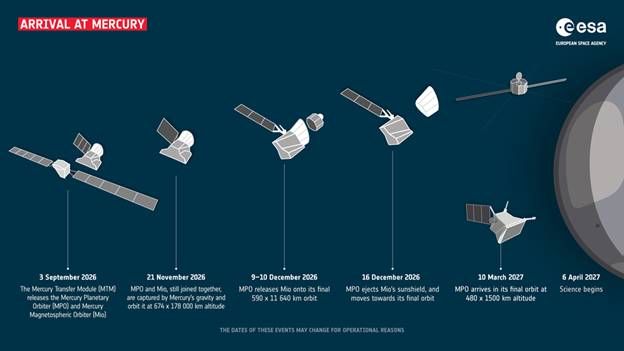
Image: © ESA
A legacy of powering space missions
BepiColombo is another example of AZUR SPACE technology supporting ambitious space programs. Its technology has supported more than 800 space projects, with missions ranging from the Hubble Space Telescope and Rosetta to JUICE and Europa Clipper.
This experience has established AZUR SPACE as a leading developer and manufacturer of high-efficiency multi-junction solar cells designed for conditions ranging from the intense heat near Mercury to the low-light environment around Jupiter.
As BepiColombo enters its next phase, the mission demonstrates how 5N+ and AZUR SPACE work with the world’s leading space agencies and aerospace manufacturers to enable some of the most demanding applications in space.